As pickleball continues to grow across southern Maine, more homeowners, schools, HOAs, and recreational facilities are investing in dedicated courts. If you’re planning a new court in Scarborough, one of the biggest decisions you’ll make is selecting the base material. While both asphalt and concrete are widely used for pickleball court construction, each offers unique advantages depending on your budget, maintenance expectations, and long-term goals.
Scarborough’s coastal climate adds another layer of complexity. Cold winters, freeze-thaw cycles, spring moisture, and occasional heavy rainfall can all affect the lifespan of a sports court. Choosing the right foundation isn’t simply about upfront cost-it’s about building a court that performs well for years with minimal repairs.
This guide compares asphalt and concrete while explaining the most important pickleball court construction details and specifications every property owner should know before starting a project.
Why the Court Base Matters
Many people focus on the colorful acrylic surface they see during play, but the real strength of a pickleball court comes from what’s underneath.
The base determines:
- Surface stability
- Ball bounce consistency
- Drainage performance
- Crack resistance
- Maintenance frequency
- Overall lifespan
Even the highest-quality acrylic coating cannot compensate for a poorly built foundation.
According to USA Pickleball and the American Sports Builders Association, both asphalt and concrete are acceptable court bases when constructed according to proper slope, drainage, and surfacing specifications.
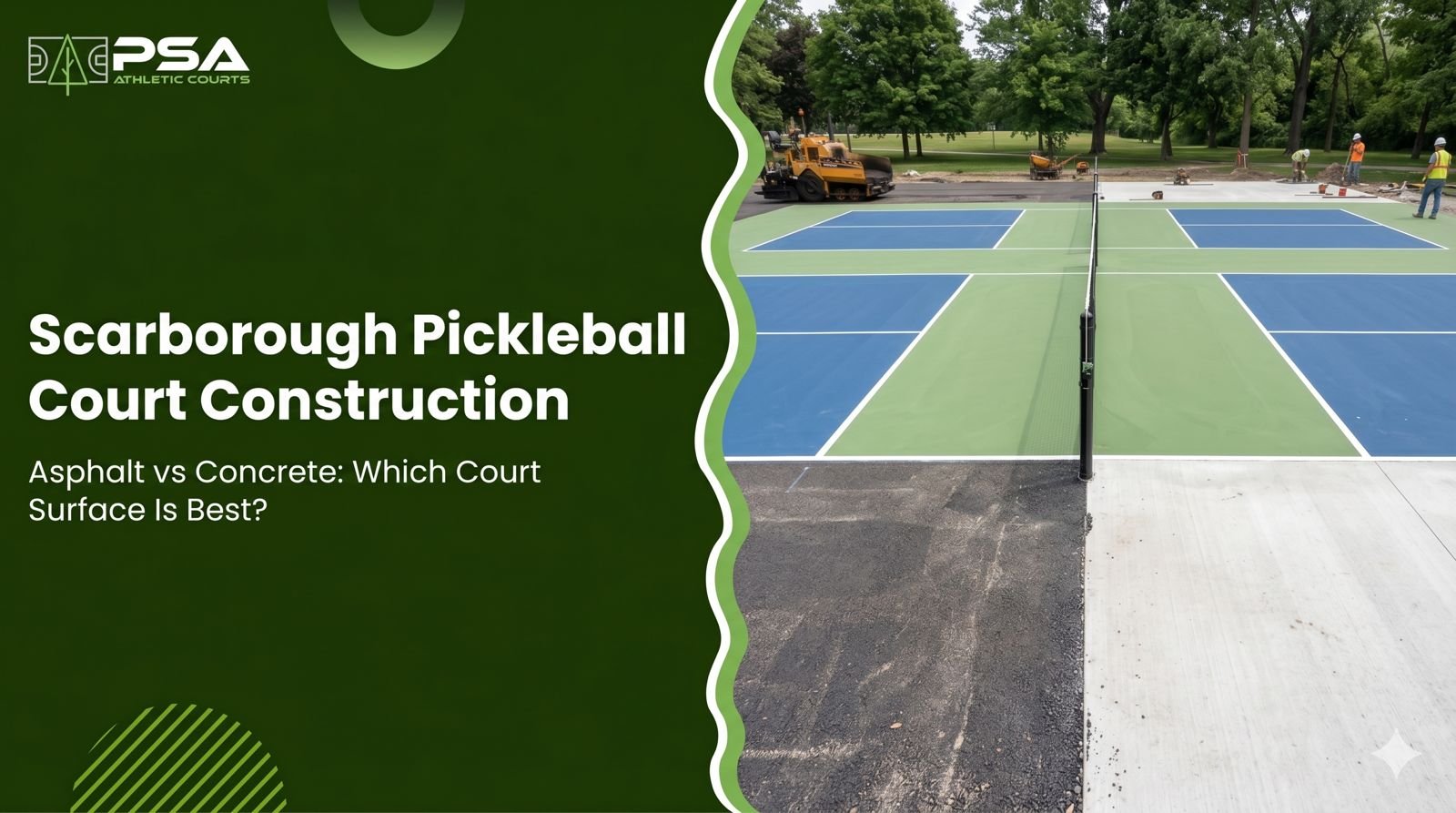
Asphalt Pickleball Courts
Asphalt remains one of the most popular options for residential courts and municipal recreation projects.
Advantages
Lower Initial Investment: Asphalt generally costs less to install than concrete, making it attractive for homeowners and community parks with fixed budgets.
Faster Installation: Because asphalt typically stabilizes sooner than concrete cures, projects can often move to the surfacing stage more quickly, reducing the overall construction timeline.
Slight Surface: Flexibility Unlike concrete, asphalt has a small amount of flexibility that may help reduce the severity of cracking caused by minor ground movement.
Easier Future Repairs: If cracks eventually develop, asphalt courts are generally easier and less expensive to repair before resurfacing.
Potential Drawbacks of Asphalt
Although asphalt performs very well, property owners should understand its maintenance needs.
Over time it may require:
- Crack sealing
- Acrylic resurfacing
- Periodic maintenance coatings
Without proper drainage, moisture infiltration can shorten its lifespan considerably.
Fortunately, routine maintenance can keep an asphalt pickleball court performing well for many years.
Concrete Pickleball Courts
Concrete provides one of the strongest and longest-lasting court foundations available.
Advantages
Outstanding Durability: Concrete offers exceptional structural strength and often lasts decades when properly installed and maintained.
Consistent Ball Bounce: Because concrete remains extremely stable, players often experience more predictable bounce characteristics throughout the life of the court.
Lower Structural Movement: Concrete is less susceptible to rutting or deformation under heavy use, making it an excellent option for schools, clubs, and public facilities.
Potential Drawbacks of Concrete
Concrete also has limitations.
These include:
- Higher installation costs
- Longer curing times before surfacing
- More difficult structural repairs if significant cracking develops
Although concrete generally requires less maintenance than asphalt, repairs can be more involved when problems occur.
Asphalt Pickleball Courts
Asphalt is one of the most popular choices for pickleball court construction, especially for residential properties and community parks.
Advantages
- Lower upfront installation costs compared to concrete.
- Faster installation, allowing the court to be ready for surfacing sooner.
- Slight flexibility helps reduce the impact of minor ground movement.
- Easier and more affordable to repair if small cracks develop over time.
Considerations
Although asphalt is an excellent option, it generally requires resurfacing more frequently than concrete. Regular inspections and proper drainage are essential to maximize its lifespan.
Concrete Pickleball Courts
Concrete is known for its exceptional strength and long-term durability, making it a preferred option for schools, sports clubs, and high-traffic recreational facilities.
Advantages
- Provides a highly stable foundation with consistent ball bounce.
- Typically lasts longer than asphalt when properly installed.
- Requires fewer structural repairs over its lifetime.
- Performs well under heavy daily use.
Considerations
Concrete usually has a higher initial installation cost and takes longer to cure before the acrylic surface can be applied. If significant cracks occur, repairs can also be more involved than asphalt.
See also: Elbow Support for Tendonitis Pain Relief: Full Guide
Which Surface Is Better for Scarborough?
The right choice depends on your project goals.
Choose asphalt if you:
- Have a limited construction budget.
- Want a quicker installation process.
- Are building a residential or recreational court.
- Don’t mind periodic resurfacing as part of routine maintenance.
Choose concrete if you:
- Want maximum long-term durability.
- Expect frequent or heavy court usage.
- Prefer fewer maintenance issues over the years.
- Are building a commercial, school, or municipal facility.
Rather than recommending one material for every project, experienced contractors evaluate soil conditions, drainage requirements, expected traffic, and long-term maintenance goals before recommending the most suitable surface.
Construction Details That Matter More Than the Material
Many construction failures occur because contractors focus on the surface rather than the foundation.
Professional pickleball court construction details include:
- Proper soil evaluation
- Base compaction
- Aggregate thickness
- Drainage engineering
- Surface slope (typically around 1%)
- Acrylic coating application
- Accurate line striping
Skipping any of these steps can significantly reduce court lifespan.
Construction Specifications Every Contractor Should Follow
Professional pickleball court construction specifications include more than dimensions.
A quality project should include:
- Official playing area of 20 × 44 feet
- Recommended total playing space of 30 × 60 feet
- Proper north-south orientation when possible
- Adequate drainage away from the court
- Stable sub-base materials
- High-quality acrylic sports coatings
Following recognized construction standards helps ensure consistent ball bounce, player safety, and long-term durability.
Which Surface Is Better for Scarborough?
Scarborough’s coastal climate experiences:
- Freeze-thaw cycles
- Heavy seasonal moisture
- Salt-air exposure
- Temperature fluctuations
Because of these conditions, material selection should be based on both environmental factors and expected court usage.
Generally:
Choose Asphalt if you:
- Want lower upfront costs
- Need quicker installation
- Plan a residential or recreational court
- Don’t mind periodic resurfacing
Choose Concrete if you:
- Want maximum longevity
- Expect heavy daily use
- Prefer lower long-term maintenance
- Are building for schools or commercial facilities
Rather than focusing solely on material, experienced builders evaluate the property, drainage conditions, soil quality, and intended use before recommending the best solution.
Work with Experienced Pickleball Court Builders
Searching for pickleball court construction companies based only on price often leads to expensive repairs later.
A qualified contractor should provide:
- Complete site evaluation
- Drainage planning
- Material recommendations
- Construction specifications
- Surface coating expertise
- Long-term maintenance guidance
Professional pickleball court designers also help optimize court orientation, drainage, fencing, and surrounding space before construction begins.
For homeowners, schools, and municipalities planning new courts in Maine, Pine State Courts specializes in custom pickleball court construction designed specifically for New England weather conditions. Whether you’re building a single residential court or a multi-court recreation facility, Pine State Courts helps clients select the right base material, optimize drainage, and create courts built for long-term performance.
To learn more about available court options, explore Pickleball Courts or review the Pickleball Court Construction Guide for Parks & Sports Facilities before starting your project.
Final Thoughts
Choosing between asphalt and concrete is one of the most important decisions in any pickleball court project. While asphalt offers affordability, faster installation, and easier repairs, concrete provides exceptional durability and long-term stability.
The right choice ultimately depends on your budget, expected usage, maintenance goals, and site conditions. Most importantly, successful pickleball court construction relies on proper engineering, quality materials, and experienced installation-not simply the surface you choose.
By working with knowledgeable professionals and following industry-standard construction specifications, you’ll enjoy a court that delivers outstanding performance for many years.